Most startup ecosystems aren't underperforming. They're working exactly as designed.
A frank examination of why ecosystems fail structurally, and what it actually takes to build one that compounds.
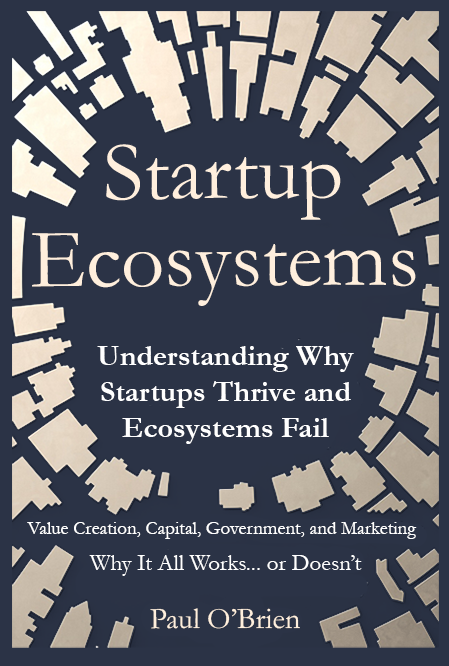
Available on Amazon · First Edition 2026 · ISBN 9798250875660
Innovation is easy to declare. Value is hard to produce.
Walk through any mid-sized city today and you'll find the language of innovation embedded in economic development websites, university mission statements, and the names of office parks that house accounting firms. It requires no proof. It demands no accountability. It just gets repeated until the repetition itself becomes the evidence.
The problem isn't corruption. It isn't negligence. The problem is design. Startup ecosystems fail structurally, and structural problems require architectural solutions, not more programs, more events, and more cohorts.
This book exists because the cost of optimizing for the wrong thing has become impossible to hide. It's being paid by founders who deserved better design, and by communities that deserved honest leadership rather than comfortable theater.
"Activity is visible. Value creation is measurable. Most regions have mastered one and ignored the other."
This is not a startup playbook. It's an architectural examination.
What this book is
- • A structural diagnosis of why startup ecosystems fail, not why founders fail
- • A framework for distinguishing real value creation from innovation theater
- • A guide to the conditions, capital architecture, and measurement systems that separate ecosystems that compound from those that stall
- • Required reading for anyone who governs, funds, builds, or operates inside a startup ecosystem
Who it's for
- Founders, who want to understand what the ecosystem is actually rewarding, and why
- Investors, who want to know why capital concentrates in certain ecosystems
- Policymakers & Economic Development Leaders, who want a diagnostic framework, not another benchmarking report
- Ecosystem Builders: accelerator operators, universities, innovation agencies
- Corporations & Institutions, who want to engage with startup ecosystems strategically, not symbolically
Six parts. One argument. Every comfortable illusion, dismantled.
The Lie of Innovation
Innovation has become something to declare rather than demonstrate. This section dismantles the confusion between activity and value creation, and explains why institutions have become so skilled at celebrating innovation rhetorically while neutralizing its effects in practice.
Innovation Without Consequence · Why Activity Is Politically Safer Than Value · Silicon Valley and the Cargo Cult of Innovation · The Institutional Fear of Reallocation · Universities, IP & the Commercialization Myth · Metrics That Reward the Wrong Behavior
The Things We Refuse to Distinguish
Startups are not small businesses. Risk capital is not development capital. Job creation is a lagging indicator, not a goal. Talent follows opportunity, not programs. These distinctions separate ecosystems that compound from those that stall.
Startups Are Not Small Businesses · Risk Capital Is Not Development Capital · Job Creation Is a Lagging Indicator, Not a Goal · Talent Does Not Follow Programs, It Follows Opportunity
Capital Is a Signal, Not a Gift
Capital follows value. It does not create it. Fundraising is a symptom of demonstrated traction, not a strategy for generating it, and ecosystems built around the capital gap narrative are misdiagnosing their own problem.
Capital Follows Value, It Does Not Create It · Fundraising Is a Symptom, Not a Strategy · TAM Delusions and the Theater of Scale · The Incentive Structure of Venture Capital
Ecosystems Fail for Structural Reasons, Not Moral Ones
Systems behave exactly as designed. When an ecosystem produces activity without scale, it is because the incentive structure rewards activity. The problem is never the participants. It is always the architecture.
Soft Landings and the Geography Illusion · Generic Accelerators and the Machinery of Activity · Public Capital, Political Incentives & Misalignment · Systems Behave Exactly as Designed
Marketing Is the Missing Discipline
Marketing is not promotion. It is market discovery: the discipline that makes demand legible before capital is raised to scale supply. Ecosystems that skip discovery to scale promotion have confused the order of operations at the most expensive possible moment.
Marketing Is Market Discovery, Not Promotion · Why Technologists Misprice Demand · Narrative Discipline and Capital Formation · Founders Who Understand People Win
What Actually Works
Conditions before programs. Capital formation as policy architecture. Density, optionality, and reallocation. KPIs that reveal structural health rather than institutional activity. The concrete, diagnostic, actionable half of the book.
Conditions Before Programs · Capital Formation as Policy Architecture · Density, Optionality & Reallocation · Ecosystem KPIs That Actually Matter · Expect Consequence
Five things this book insists on taking seriously.
"Startups are not small businesses."
A startup is a temporary organization searching for a scalable, repeatable business model under genuine uncertainty. Policies built for small businesses serve neither. The conflation collapses what both actually need into a compromise that serves neither well.
"Capital follows value. It does not create it."
When capital is absent from an ecosystem, it is rarely because investors are unaware. It is because the signal is weak, and weak signal is a problem more capital cannot solve, because capital is the thing that responds to signal rather than the thing that generates it.
"Job creation is a lagging indicator, not a goal."
A startup that hires aggressively before finding product-market fit is not demonstrating ambition. It is demonstrating it may not survive long enough to matter. Jobs follow productivity; they don't precede it.
"Systems produce exactly the outcomes they are designed to produce."
An ecosystem that generates programs without exits is not confused. It is calibrated for activity and producing it with admirable efficiency. The design is the problem, and accepting that framing is the turning point the second half of the book depends on.
"Marketing is market discovery, not promotion."
The founders who skip discovery to scale promotion have confused the order of operations at the most expensive possible moment. Demand reveals itself in transactions, not compliments, surveys, or letters of intent.
Written from proximity, not distance.
Paul O'Brien has occupied every seat at the table: founder, investor, mentor, ecosystem builder, program director, and policy advisor. He has started companies, failed at some and exited others. He learned through customers that they don't care how hard you worked to build something; they care whether their problem is solved. He watched the same story repeat itself across cities, states, and countries: everyone sincere, outcomes rarely matching ambition.
Startup Ecosystems is not a criticism from a comfortable distance. It is a clarification from proximity, and from the kind of frustration that only comes from caring deeply about something that keeps going wrong in predictable ways.
Request a Consultation
For governments, economic development agencies, corporations, and institutions seeking a diagnostic assessment, structural design engagement, or ongoing advisory partnership.
Book Paul as a Speaker
Paul speaks on ecosystem design, capital formation, structural conditions for entrepreneurship, and why most regions are measuring the wrong things. Keynotes, panels, workshops.
"The problem wasn't corruption. It wasn't even negligence. The problem was design."
"A startup that hires aggressively before finding product-market fit is not demonstrating ambition. It is demonstrating that it may not survive long enough to matter."
"Startups are not small businesses. They are temporary organizations searching for scalable, repeatable business models under conditions of genuine uncertainty."
"Consequence is a choice. Make it deliberately."
Paul O'Brien: Keynote Speaker & Workshop Facilitator
For audiences ready to hear what ecosystem development actually requires, and what most regions are consistently getting wrong.
Innovation Theater vs. Value Creation
Why most startup ecosystems are producing exactly what their incentives are designed to produce, and how to change the design.
Capital Follows Value: The Signal Problem No One Talks About
Why the capital gap narrative misdiagnoses the problem, and what investors are actually looking for when they evaluate an ecosystem.
Conditions Before Programs
A diagnostic framework for ecosystems that want to stop repeating the same mistakes.
Expect Consequence
What it looks like to build an ecosystem around asymmetric outcomes, honest measurement, and structural patience.
Build for consequence or admit you prefer comfort.
Startup Ecosystems is available now on Amazon.
Give them something worth staying for.