The Nordic Operating System
The reference design for a high-floor economy, and why a world-class foundation still has to convert
Across 117 economies, the Nordic countries, Denmark, Sweden, Norway, and Finland, function less like four separate economies than like four installations of the same operating system: a shared institutional architecture of universal welfare, high trust, and coordinated governance that the comparative-capitalism literature has long treated as a distinct model. The IEPA lets us see what that architecture produces, zone by zone. What it produces is dominance of the Foundations, the capability and institutional layer beneath realized prosperity. All four Nordics rank in the global top ten on resilience, and three of the four on alignment and on innovation. No other region concentrates at the base of the index this way. But the same data carries a discipline the Nordic admirers rarely hear: the operating system is world-class, and the conversion layer is not. Every one of the four has foreign-investment attraction or realized prosperity as its weakest zone. Even the best foundations on earth do not convert themselves.
- The Nordics own the foundations. Four of four rank top ten globally on resilience, three of four on alignment and on innovation; Sweden leads the world on innovation, Finland on resilience, Denmark on alignment.
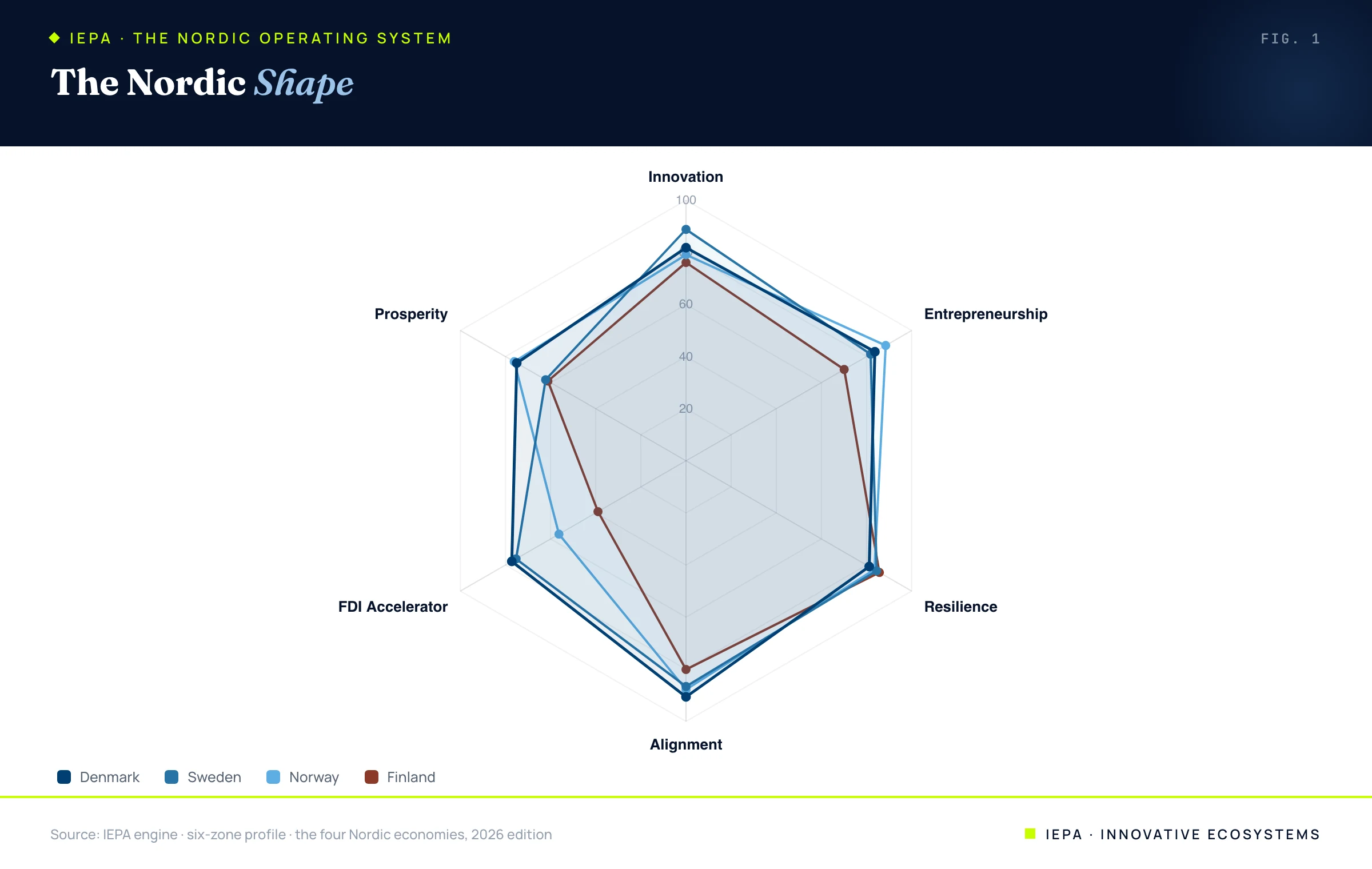
- Denmark is the reference design. Its six zones sit within a 16-point band, the most balanced profile of any leading economy, and its floor of 75 is among the highest in the index.
- The model is not uniform. Finland is genuinely lopsided, its foreign-investment zone collapsing to 39 against a resilience peak of 86.
- The conversion gap is universal, even here. The Nordic mean on the Foundations zones is the low-to-mid 80s; on the FDI Accelerator it is 62 and on realized prosperity 69. A great floor, a softer ceiling.
If the lesson of our research is that prosperity is built at the floor rather than the ceiling, then the Nordic economies are the closest thing the world has to a finished blueprint. They do not win every zone, and one of them is more lopsided than its reputation suggests. But on the institutional foundations that determine how high an economy's floor can sit, the four Nordics are, collectively, without peer.
01One Operating System, Four Installations
The idea that the Nordic countries share a single economic model is not a metaphor we invented; it is one of the most durable findings in comparative political economy. In the canonical typology, the Nordic states form their own category, a social-democratic regime distinguished from the liberal Anglo-American model and the conservative continental one by universal welfare provision, high public trust, and a deliberate coordination between state, labor, and capital. Esping-Andersen's account of these three worlds of welfare capitalism remains the reference, and the Nordic world is its most coherent member.
What that coherence means in IEPA terms is a shared shape. Plot the four Nordic profiles across the six zones and they trace nearly the same figure: full and high across innovation, entrepreneurship, resilience, and alignment, then pulling inward at the foreign-investment vertex. They are four installations of one architecture, and the architecture has a signature.
02Who Owns the Foundations
The Nordic strength is not spread evenly across the index; it is concentrated with unusual precision in the Foundations, the four zones, innovation, entrepreneurship, resilience, and alignment, that together measure an economy's capability and the institutions that deploy it. To see how concentrated, we counted how many of the four Nordics appear in the global top ten of each zone.
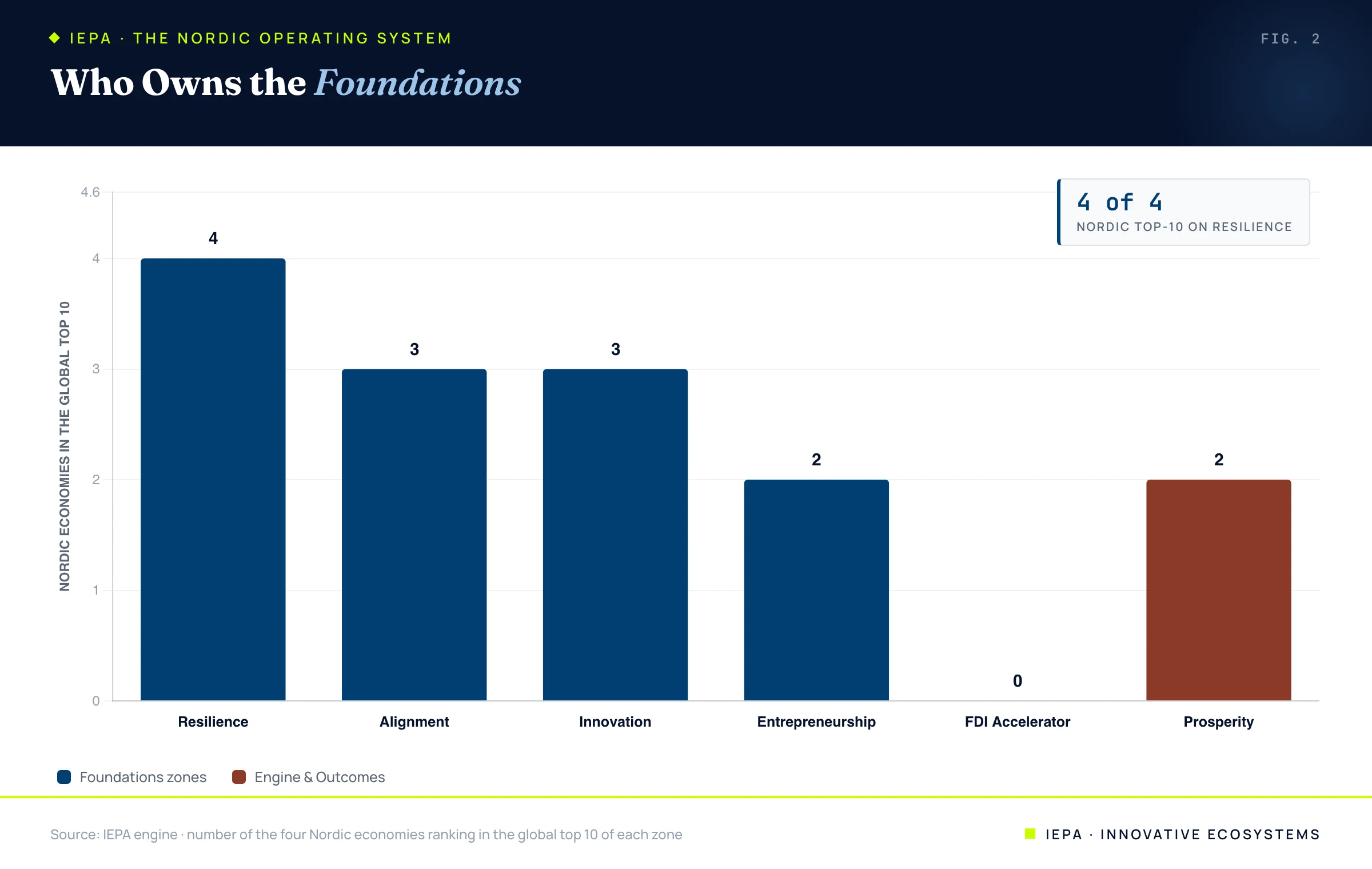
The result is one of the most concentrated regional signatures in the entire index. All four Nordic economies rank in the global top ten on resilience, and three of the four on alignment. Three of the four also make the top ten on innovation. Sweden holds the highest innovation score in the world, Finland the highest resilience, Denmark the highest alignment. On the institutional and capability base of competitiveness, four small countries of fewer than thirty million people between several of them occupy a share of the global frontier that no other cluster approaches.
And then the signature inverts. On the FDI Accelerator, the number of Nordics in the global top ten is zero, and on realized Prosperity Outcomes only Denmark and Norway break in. The economies that own the foundations of the index own none of its capital-attraction peaks and only a minority of its outcome peaks. That is not a failure; it is the shape of the model, and it is the most instructive thing about it.
03Denmark, the Reference Design
If one economy deserves to be called the reference installation, it is Denmark. Across all six zones Denmark scores within a roughly sixteen-point band, from an alignment high of 90 to a prosperity floor of 75, the most balanced profile of any leading economy in the index. Its weakest zone, at 75, would be a strong zone for most countries; it sits among the highest floors anywhere. Denmark is, in the most literal sense the index can measure, the economy with the fewest weak links.
Denmark is not the best at any one thing the world rewards loudly. It is merely the economy with no weakness, and in a system where the floor decides the outcome, that is the rarest strength of all.
This is the Balance Premium made into an architecture. Where Singapore achieves its balance through deliberate state coordination of a small open economy, Denmark achieves it through the Nordic settlement, a universal institutional floor that lifts every zone at once and lets none collapse. Two very different political systems arriving at the same structural answer: build the floor, not the spike.
04The Model Is Not Uniform
It would be easy, and wrong, to treat the four Nordics as interchangeable. The data insists on a correction. Finland, the most admired of the group in many innovation rankings, is in IEPA terms the most lopsided of the four. Its resilience score of 86 is the highest in the world, and its alignment is elite, but its foreign-investment zone falls to 39, more than forty points below its own institutional peak and a level that would not look out of place in a far less developed economy.
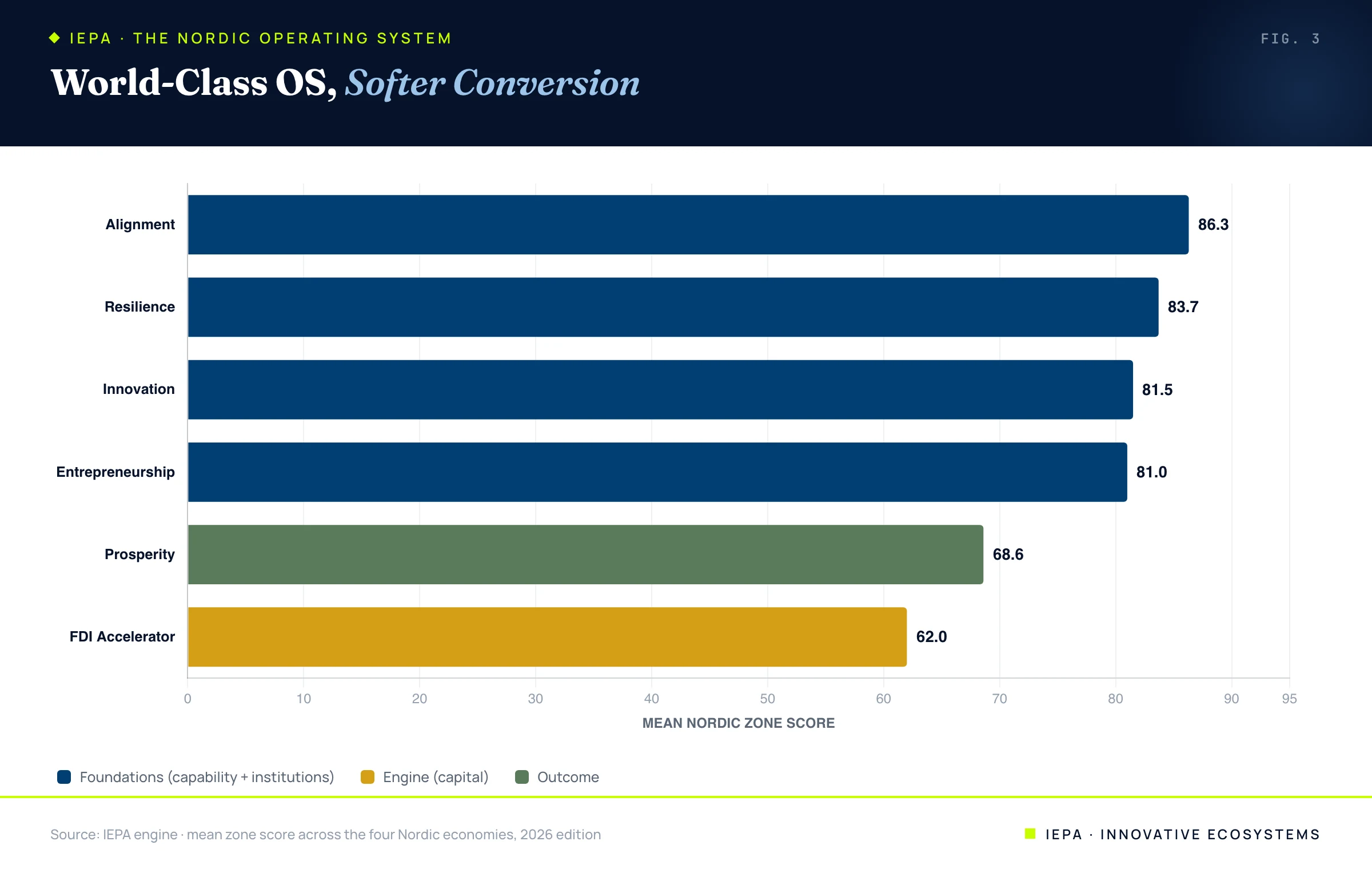
Finland is the clearest case, but the pattern holds across the group. Averaged over the four economies, the Nordic mean on the Foundations zones runs from 81 to 86, world-class on every one. On the FDI Accelerator the mean falls to 62, and on realized Prosperity Outcomes to 69. The operating system, the capability and institutions, is built to a standard almost no one matches. The conversion layer, the actual attraction of foreign capital and the translation of capability into the highest realized prosperity, is merely good.
05What the Nordic Model Teaches
The Nordic economies resolve one question and pose another. They resolve the question of whether a high floor is achievable: it is, and the institutional architecture that produces it is well understood and, in its broad strokes, deliberately built rather than inherited. A region that wants to raise its weakest zones has, in the Nordic settlement, a worked example of how an institutional floor lifts every capability at once.
But they pose the harder question that runs through all of our research. If the Nordics have built the best foundations on earth and still do not lead the world on capital attraction or on realized prosperity, then foundations, however excellent, are not the end of the story. Capability and institutions are necessary, and the Nordics prove they can be engineered. Conversion, the apparatus that turns a world-class base into world-leading capital and outcomes, is a separate function, and even the Nordics have built it less completely than they have built the base beneath it.
This is precisely the seam Innovative EcoSystems works. The Nordic model shows that the foundation can be built; our HoldCo-to-SPV architecture is built for the layer above it, the conversion of strong foundations into capital that actually enters and prosperity that is actually realized. The Nordics are the proof that a high floor is possible. The conversion gap that sits even on top of their floor is the proof that a high floor, by itself, is not enough.
All zone scores, ranks, and dispersion statistics are computed from the proprietary IEPA engine maintained by Innovative EcoSystems, 2026 edition. Related sources below.
- Esping-Andersen, G. (1990). The Three Worlds of Welfare Capitalism. Princeton University Press.
- Innovative EcoSystems. The IEPA Index, State of the Index 2026, Singapore vs the United States, and Lopsided (companion papers).
- WIPO (2024). Global Innovation Index 2024.
- World Justice Project. Rule of Law Index 2025.
- UNDP. Human Development Index data.
Singapore vs the United States
Two number-one stories, two completely different machines. A tale of depth against breadth.
→Explore the IEPA
Six zones, every market this research is scored from.
→Open the Atlas
The live global registry this research is drawn from.
→