The Gulf's Bet
A region that bought prosperity before it built capability, and the wager on whether the order can be reversed in time
The Gulf economies are a genuine anomaly in the index, and a useful one, because they invert the relationship the rest of our research has established. Where most economies earn their prosperity through capability, the Gulf states have prosperity that their capability does not explain. Across all 117 economies we can measure the prosperity premium, how much more prosperity an economy realizes than its underlying capability would predict, and four of the six largest premiums on earth belong to Gulf states. This is the visible signature of a rentier economy: prosperity funded by resource rents rather than produced by domestic capability. The strategic question, and the one the entire region is now spending enormously to answer, is whether prosperity that was bought can be converted into prosperity that is built, before the energy transition makes the rents that pay for it less reliable. The data shows the conversion underway, and far from finished.
- The profile is inverted. The UAE realizes 85 on prosperity but sits in the mid-50s across its capability zones. The outcome is the peak; the capability is the base.
- The prosperity premium is the largest in the world. Qatar, the UAE, Saudi Arabia, and Bahrain all rank in the global top thirteen for prosperity unexplained by capability.
- Capability is rising, slowly. UAE innovation climbed from 49 to 57 over the decade, Saudi Arabia from 46 to 53. The bet is being paid into, gradually.
- The outcome hinges on alignment. Whether rents become a curse or a launchpad is decided by institutional quality, and within the Gulf, the economies with stronger alignment are the ones furthest along.
Almost every economy in the IEPA tells the same causal story: build capability, attract capital, realize prosperity, in that order. The Gulf states tell it backwards. They have the prosperity and the capital already, sitting on top of a capability base that has not yet been built to match. They are, in effect, running economic development in reverse, and betting they can complete the sequence before the thing that funds it fades.
01The Upside-Down Economy
To see what makes the Gulf unusual, look at the shape of a single Gulf economy from the bottom up. The United Arab Emirates is the clearest case: the most prosperous and most diversified of the group, and the one furthest along the path the others are following.
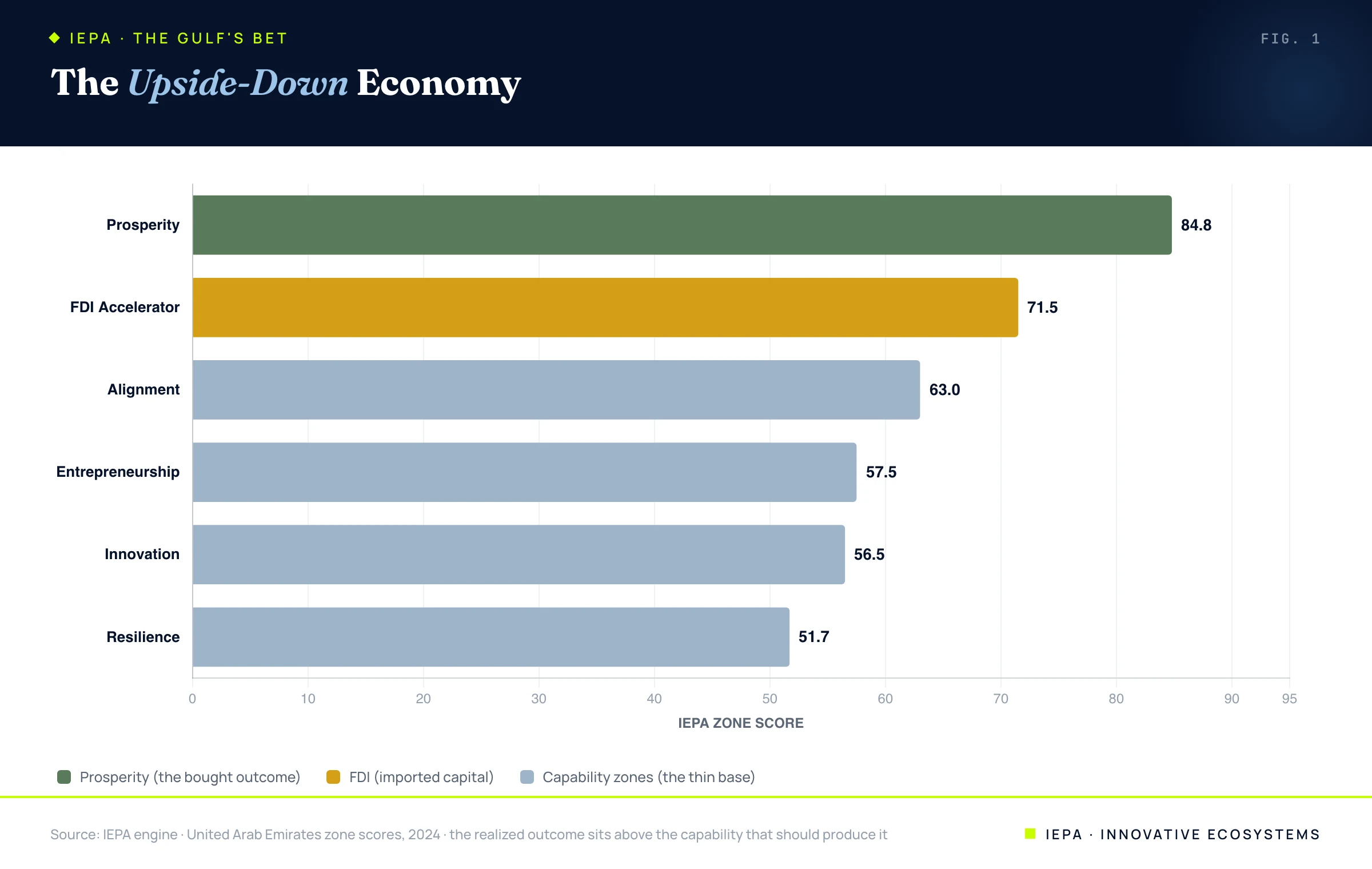
In a typical economy this chart is the other way up: capability zones at the top, with prosperity as a downstream result that rarely exceeds them. The Emirati profile is inverted. Its realized prosperity, 85, is elite, near the very top of the global distribution. Its imported capital, an FDI score of 72, is high. But the zones that are supposed to generate that prosperity, innovation at 56, entrepreneurship at 57, resilience at 52, sit a full thirty points below the outcome they are nominally responsible for. The result is an economy whose visible success rests on a base that has not yet grown to support it. The prosperity is real. The engine underneath it is still being assembled.
02Bought, Not Built
This gap can be measured precisely. For every economy we compute the difference between its realized prosperity and the average of its five capability zones, a prosperity premium that captures how much of an economy's success is unexplained by what it can actually do. A high premium is the statistical fingerprint of rent: prosperity arriving from somewhere other than domestic capability. The Gulf dominates the global ranking.
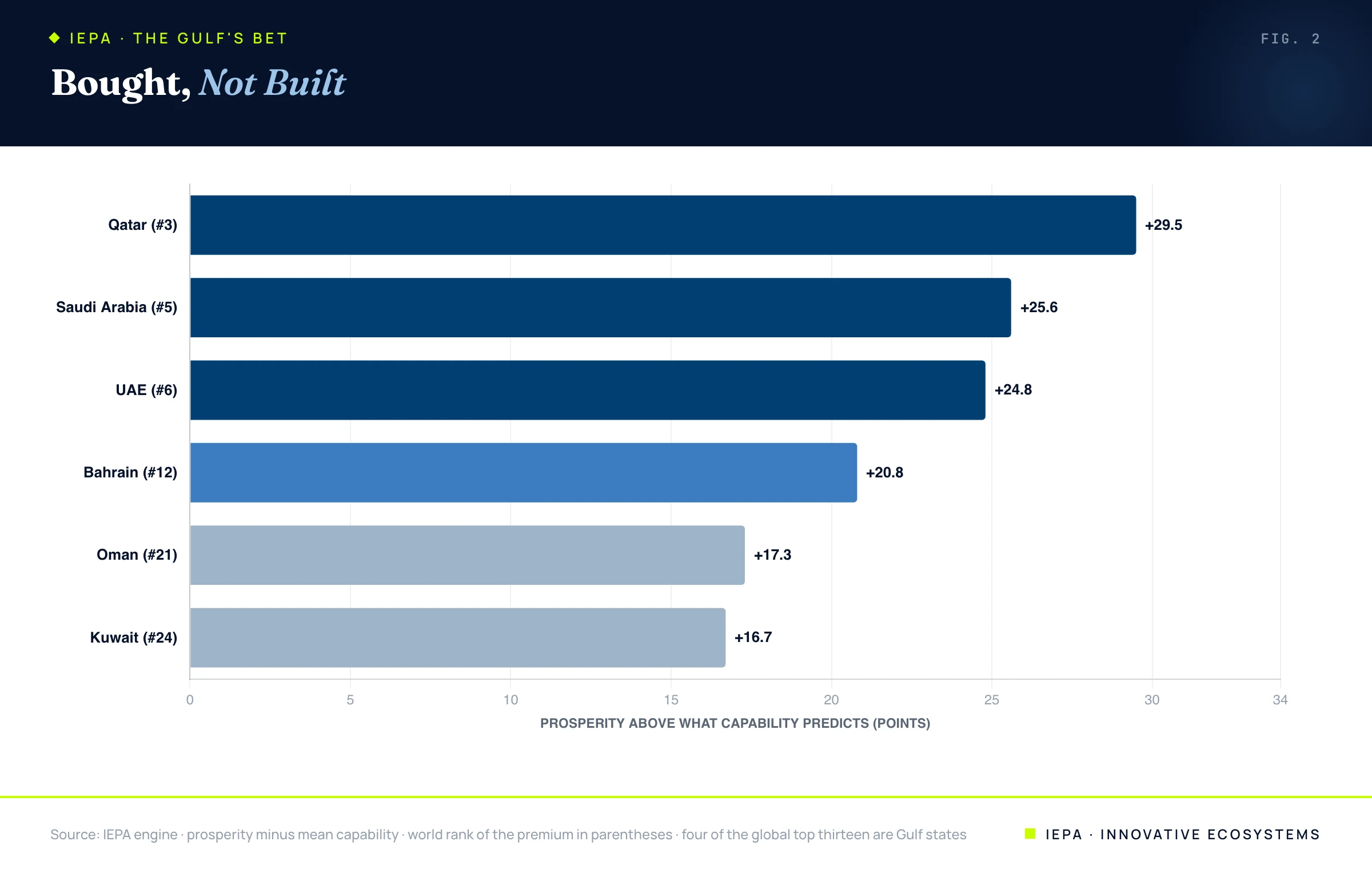
Qatar realizes 29 points more prosperity than its capability predicts, the 3rd-largest gap on earth. Saudi Arabia and the UAE follow at 5th and 6th. Bahrain ranks 12th. No other region clusters at the top of this measure the way the Gulf does, and the reason is the one the development literature has described for half a century. The Gulf states are the textbook rentier economies, their prosperity historically a function of resource rents rather than of the productive base of the domestic economy. The classic rentier state model holds that an economy funded by external rents tends to develop a weak link between what it produces and what it consumes, exactly the disconnect the prosperity premium measures. The Gulf has bought a standard of living its own capability has not yet earned.
Most economies earn their prosperity. The Gulf bought it first, and is now trying to build, in arrears, the capability that was supposed to come before it.
03The Bet
None of this would matter much if the rents were permanent. They are not, and every government in the region knows it. The entire strategic posture of the Gulf, the sovereign wealth funds, the free zones, the universities flown in wholesale, the Visions branded by year, is a single enormous wager: that the prosperity rents have already bought can be used to purchase the capability that rents alone cannot create, and that the capability will be self-sustaining before the energy transition erodes the rents. They are spending the proceeds of the old economy to manufacture a new one.
The question the index can answer is whether the bet is being paid in. It is, slowly.
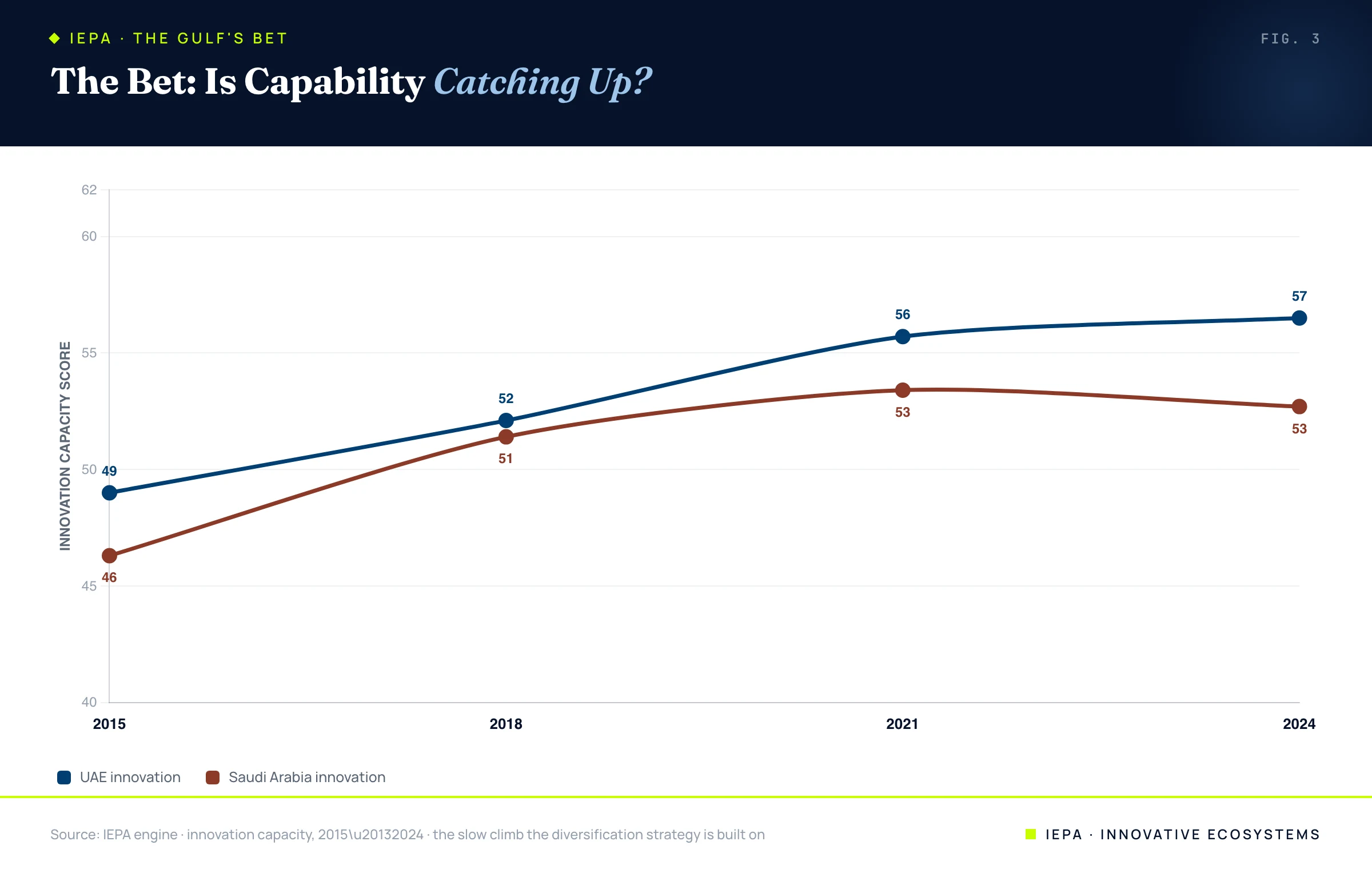
UAE innovation capacity rose from 49 to 57 over the decade, and Saudi Arabia's from 46 to 53. These are real gains, the visible accumulation of the capability the strategy is designed to produce, and the deal flow of 2026 shows them compounding: in recent months the Emirati operator du and the investor Shorooq stood up a fifty-million-dollar fund to back regional startups, one of a wave of new GCC vehicles, Khwarizmi Ventures' seventy-million-dollar second fund among them, channelling Gulf capital into the early-stage ecosystem the region is trying to build. But they are also modest against the size of the gap they are meant to close: even after a decade of climbing, both economies' capability still sits far below the prosperity it is supposed to underwrite. The conversion from bought to built is happening at the pace of institutions and human capital, which is to say slowly, while the prosperity that funds it remains tied to a commodity cycle that the world is actively trying to leave behind. The bet is live. It is not yet won.
04What Decides the Wager
Whether resource wealth becomes a curse or a foundation is not random, and the deciding variable is one this research has already isolated. The resource-curse literature converged long ago on the finding that institutional quality is what separates the economies that squander rents from those that compound them, and the IEPA's own data says the same thing in its own terms. Within the Gulf, the economies with the strongest institutional alignment are precisely the ones furthest along the conversion: the UAE, with the highest alignment in the group, is the most diversified and the most prosperous, while the more rent-dependent profiles sit on thinner institutional bases.
This connects the Gulf's bet to the central finding of our work on alignment, that institutional coherence is the hidden variable that determines whether capability converts into capital and prosperity. For the Gulf, alignment is the variable that determines whether the rents are invested into a durable economy or merely consumed. The states that build coherent institutions alongside their physical infrastructure will convert the bet; the states that build only the infrastructure will, when the rents fade, find they bought a standard of living without the means to keep it.
05What the Gulf Teaches
The Gulf is the exception that confirms the rule the rest of our research establishes. Everywhere else, capability comes first and prosperity follows. The Gulf reversed the order using a resource windfall, and in doing so created the one large group of economies whose prosperity genuinely outruns their capability. That is not a stable equilibrium; it is a race between a depreciating asset and a slowly appreciating one.
For Innovative EcoSystems, the Gulf is the most vivid demonstration of why capability and the institutions that convert it are the only durable foundation for prosperity. Rents can buy the outcome for a while. They cannot buy the engine. A region that wants prosperity it can keep has to build the capability and the alignment that produce it, and the role we play, packaging a region's anchors and commitments into credible, investable structure, is precisely the work of converting bought advantage into built advantage. The Gulf is spending a fortune to learn the lesson at national scale. The lesson is that the engine has to be built, and that the building cannot be skipped, only, with enough capital and enough institutional discipline, accelerated.
All zone scores, prosperity premiums, ranks, and trajectories are computed from the proprietary IEPA engine maintained by Innovative EcoSystems. Related sources below.
- Beblawi, H., & Luciani, G. (1987). The Rentier State. Croom Helm. (Revisited, British Journal of Middle Eastern Studies, 2020.)
- Innovative EcoSystems. The IEPA Index, Alignment Is the Hidden Variable, and Lopsided (companion papers).
- WIPO (2024). Global Innovation Index 2024.
- UNCTAD (2024). World Investment Report 2024.
- UNDP. Human Development Index data.
- du and Shorooq partner on a $50 million fund to back regional startups. Wamda, June 2026.