Coherence Comes First
Alignment is usually read as a result. The data reads it as a precondition. It is not a lever an economy pulls. It is the floor the economy stands on.
The fourth IEPA zone, Alignment, measures whether an economy's institutions point in the same direction: the coherence of its governance, the predictability of its rule of law, the credibility of its public commitments. Our earlier work showed that alignment predicts the outcomes every economy wants. This piece asks the prior question, where alignment sits in the structure, and the answer reframes the zone.
- Alignment binds up, not down. It correlates with the capability zones above it far more tightly than with the outcomes below it: Resilience 0.93, Innovation 0.78, Entrepreneurship 0.77, against Prosperity 0.63 and foreign investment 0.39. It moves with what an economy can do, not with what it has already collected.
- The coherence floor is worth +25 points of capability. Split the 117 economies at median Alignment and the high half out-innovates the low half by 25.5 points, the widest gap of any zone pairing in the index, alongside +18 in foreign investment and a 21-point lead on the composite.
- Institutions are upstream, not a payoff. Alignment is the slowest, hardest-to-fake zone, and the one the others co-vary with. Capability does not produce coherence; it accumulates on top of it. This is the institutions literature, located in the data.
- Two economies, one score, opposite orders. China builds a world-class research frontier on a thin institutional floor; Costa Rica lays a benchmark-grade floor while its capability is still rising. They meet near the same composite by opposite routes, and only one of them has the ground to keep compounding.
Every other zone in the index is something an economy does. It invents, it commercializes, it attracts capital, it produces prosperity. Alignment is the only one that is something an economy is. It is not an activity with an output; it is the condition the activities run on. That difference is easy to miss, because alignment shows up in the same leaderboards as the others and gets read the same way, as one more score to raise. The data says it should be read differently. It is not a result the other zones produce. It is the surface they are built on.
01What the Zone Measures
The IEPA's Alignment zone captures institutional coherence: rule of law and the even application of rules, government effectiveness and regulatory quality, the control of corruption, the credibility and stability of policy over time. It is not a measure of how clever an economy is or how much money moves through it. It is a measure of whether the machinery underneath holds its shape, so that a contract signed today still means the same thing in a decade.
This is the oldest idea in development economics, and the most quietly decisive. Douglass North defined institutions as the humanly devised constraints that structure economic life, the rules of the game beneath every transaction, and argued that it is the quality of those rules, more than resources or technology, that explains why some economies compound and others stall. Dani Rodrik, Arvind Subramanian, and Francesco Trebbi later put the competing explanations for development in a single horse race and found that institutions did not merely matter; they dominated geography and trade openness once all three were measured against each other. Alignment is the IEPA's measurement of exactly that variable. The question this piece asks is not whether it matters, which is settled, but where in the system it lives.
02Alignment Points Up, Not Down
If alignment were a result, a thing the productive zones generate as they succeed, it would track the outcomes most closely. It does the opposite. Correlate alignment with every other zone across all 117 economies and the pattern is unambiguous: the strongest bonds are upstream, with the capabilities, and the weakest are downstream, with the outcomes those capabilities are supposed to deliver.
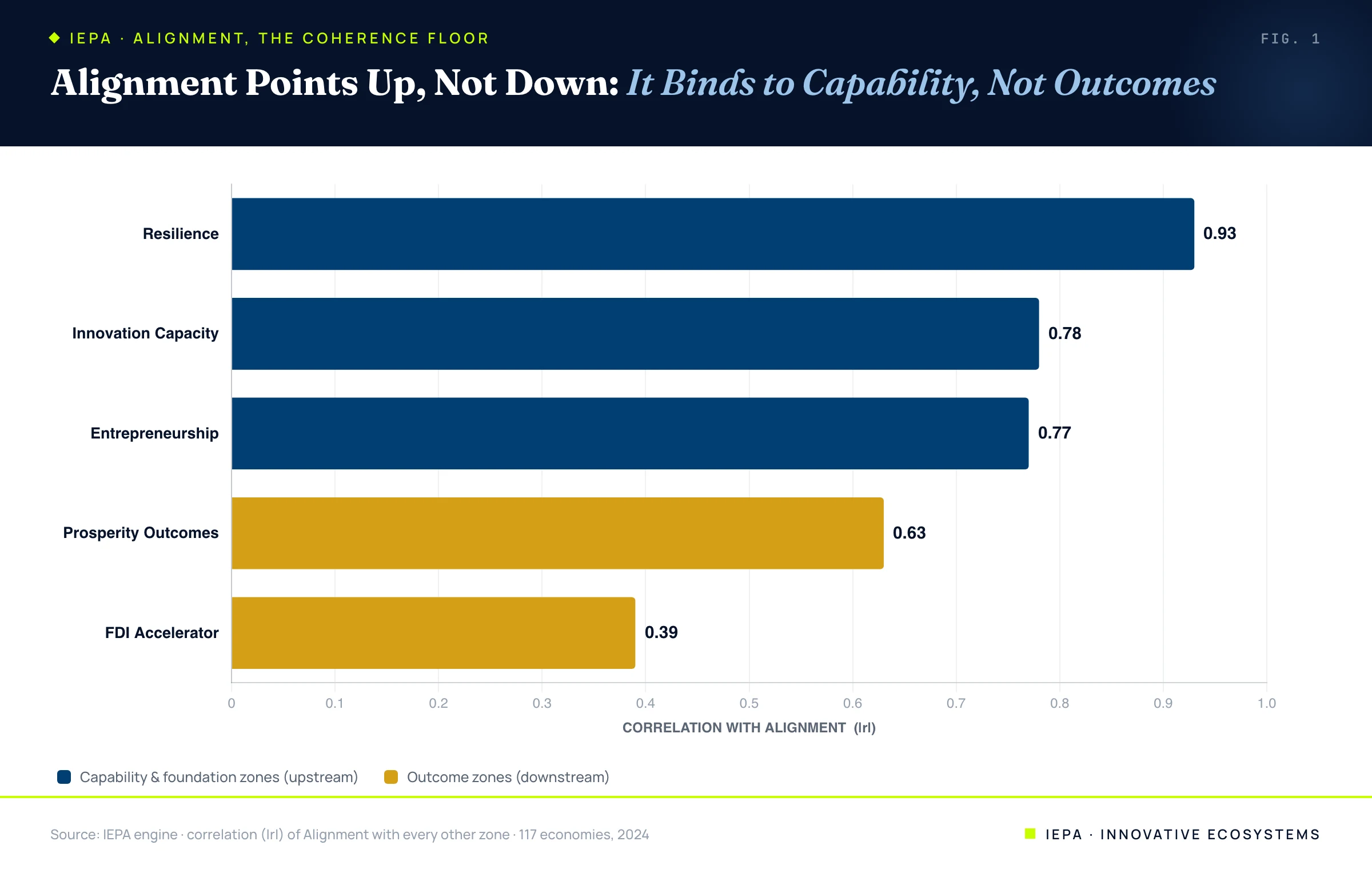
Alignment and Resilience move almost as one, at 0.93, because they are the two halves of the same institutional bedrock: coherent rules and the stability to keep them. Above that bedrock, alignment still binds hard to the productive capacities, 0.78 with innovation and 0.77 with entrepreneurship, because an economy cannot sustain a research frontier or a founding culture on rules that do not hold. But the link to foreign investment, the outcome regions chase hardest, is the weakest of all at 0.39. The thing alignment co-moves with is capability. The thing it barely co-moves with is the prize. That is the signature of a precondition, not a product. A floor correlates with the height of the building it carries, not with the value of the tenants who eventually move in.
03The Coherence Floor
The structural reading has a blunt, measurable consequence. If alignment is the floor the capability stack stands on, then economies with more of it should carry more capability. They do, and the size of the effect is the largest in the index.
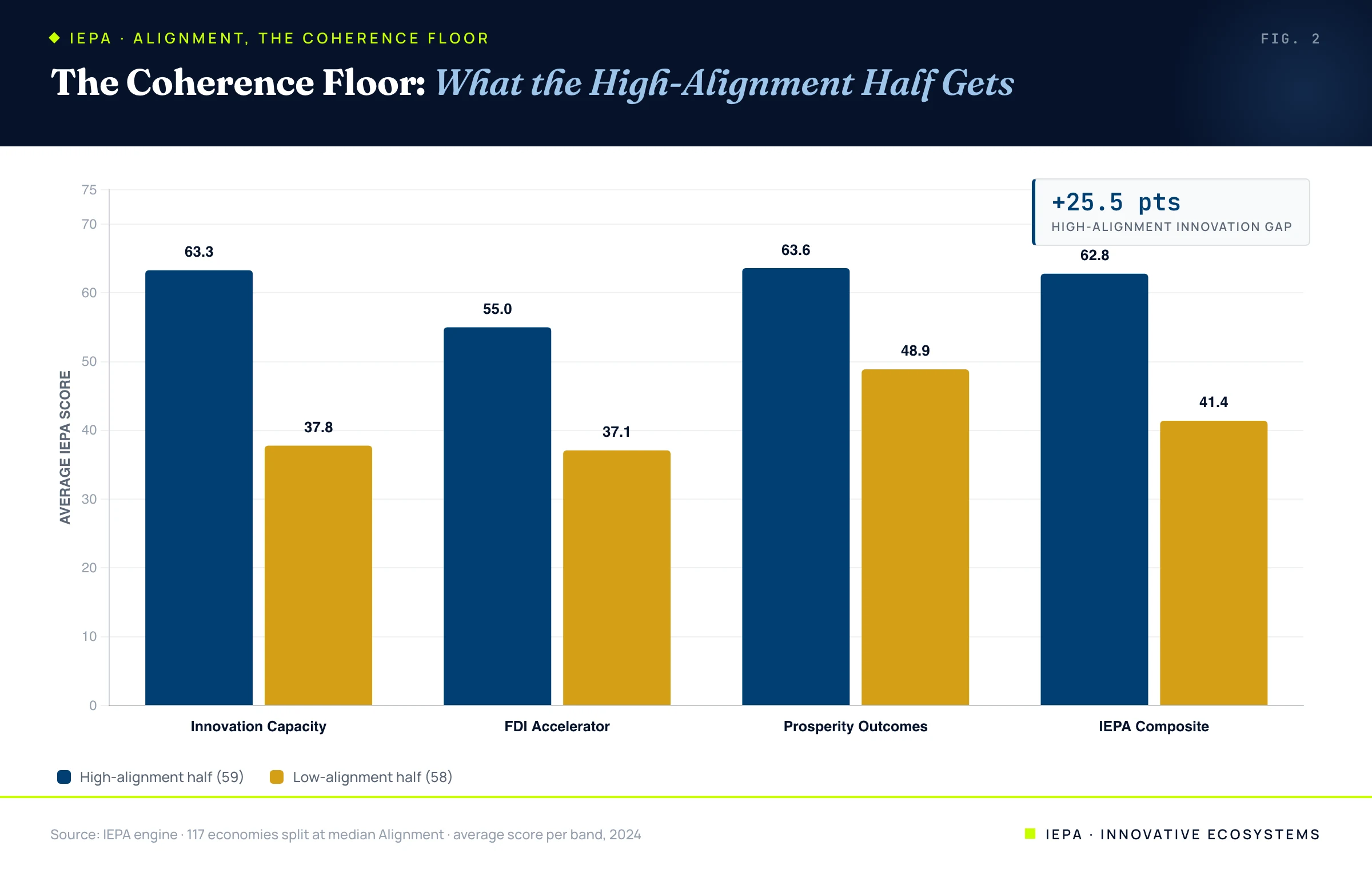
The 25.5-point innovation gap is the widest separation any single zone produces when the field is cut in half, wider than the foreign-investment gap, wider than the prosperity gap. That ordering is the tell. If alignment were just a marker of rich, successful economies, its largest associated gap would be with prosperity, the marker of success. Instead its largest gap is with innovation, the capability that sits directly on top of it. Coherence does its heaviest work one floor up, on what an economy is able to build, and only then, more diffusely, on what it eventually earns. The institutions come first, the capability rises on them, and the outcomes arrive last and least tied to the floor that made them possible.
| Economy (2024) | Alignment | Innovation | Composite |
|---|---|---|---|
| Finland | 80 | 76 | 65 |
| Singapore | 74 | 76 | 77 |
| Germany | 72 | 78 | 65 |
| South Korea | 70 | 75 | 64 |
| Costa Rica | 68 | 45 | 53 |
| United States | 68 | 78 | 71 |
| Israel | 67 | 74 | 62 |
| China | 42 | 81 | 55 |
Costa Rica and China are the two instructive entries. Costa Rica posts an Alignment of 68, fifth in this group and ahead of the United States, on an Innovation Capacity of just 45. It has laid a benchmark-grade institutional floor while the building on top of it is still going up. China is the mirror image: the highest Innovation Capacity in the entire index at 81, on an Alignment of 42 that sits near the bottom of the curated field. It has built a world-class frontier on a thin floor.
04Two Roads to the Same Score
The two economies arrive at nearly the same place. China's composite is 54.8, Costa Rica's is 52.7, close enough to be neighbors on the board. But they got there by opposite construction orders, and the order is the whole story. Costa Rica built the floor first and is raising capability onto ground that will hold it. China raised capability first, onto a floor the rest of the index says is too thin to let that capability fully convert: its foreign-investment intensity is among the lowest of any major economy, and the institutional discount is the standing explanation. One of these economies can keep compounding because the surface beneath it is sound. The other has built high on ground that constrains how much of that height ever turns into durable prosperity.
This is what it means for a zone to be upstream. A region can buy an incubator, stand up a fund, or win a marquee plant in a single budget cycle, and its capability scores will move. It cannot buy coherence the same way, because coherence is made of rule of law, predictability, and trust that accumulate over years and collapse faster than they build. North's central warning was precisely this asymmetry: institutions are path-dependent, slow to form and easy to erode, which is why they, and not the faster-moving inputs, set the ceiling on everything built above them.
You can raise the building in a budget cycle. The floor takes a generation, and it decides how high the building is allowed to go.
05The Builder's Reading
For a region, the practical lesson inverts the usual sequence. The instinct is to compete on the visible capabilities first, the research output and the startup counts, and to treat governance reform as a slow background project for later. The data argues for the reverse. Alignment is the zone the others co-vary with, the floor that decides how much of any capability investment actually compounds, and the first thing a serious allocator checks before committing capital for a decade. Building it is not preparation for the real work. On this evidence, it is the real work, the part that determines whether everything else pays off.
That does not mean a region waits for perfect institutions before doing anything else; Costa Rica did not, and neither did any economy now near the top. It means treating coherence as the load-bearing investment rather than the deferred one, sequencing the institutional floor alongside the capability above it instead of behind it. The economies that compound are not the ones that built the most impressive thing fastest. They are the ones that built it on ground that holds. Of the six lenses, Alignment is the one that is least visible from the outside and most decisive from underneath, because it is not one of the things an economy does. It is the surface every one of those things is standing on.
Zone scores, the median-split bands, and all correlations are computed on the live IEPA engine across 117 economies for the 2024 assessment year, the headline reference vintage, with later years treated as trend extension. Scores are normalized 0 to 100. No estimates.
- North, D. C. (1990). Institutions, Institutional Change and Economic Performance. Cambridge University Press.
- Rodrik, D., Subramanian, A., & Trebbi, F. (2004). Institutions Rule: The Primacy of Institutions over Geography and Integration in Economic Development. Journal of Economic Growth, 9(2), 131–165.
- Innovative EcoSystems. Alignment Is the Hidden Variable. 2026.
- Innovative EcoSystems. Why We Built Six Zones Instead of One Number. 2026.
- Innovative EcoSystems. The IEPA Index and Methodology. 2026.
Everyone Has a Zone
More than 2,300 special economic zones exist and almost no economy is without one. The record calls them a second-best that delays the reform they substitute for.
→Explore the IEPA
Six zones, every market this research is scored from.
→Open the Atlas
The live global registry this research is drawn from.
→