Resilience as Competitiveness
Resilience is sold as insurance. The data says it is a premium the market pays. Finland's 85 is an asset, not a safety net.
The third IEPA zone, Resilience, measures whether an economy can take a hit and keep going: the strength of its institutions and rule of law, its political and financial stability, its environmental sustainability, and the peace and human development that hold a society together through a shock. It is the zone most often treated as defense. The evidence says it is offense.
- Resilience pays, and not in survival alone. Split the 117 economies at the median. The resilient half attracts about 18 points more foreign investment and realizes about 16 points more prosperity than the fragile half, and sits 22 points higher on the composite.
- It underwrites the whole index. Resilience correlates with the IEPA composite at 0.89, the tightest of any zone, because durable institutions are the ground every other capability is built on.
- The resilient core is Nordic. Finland leads at 85, with Sweden, Norway, Denmark, Switzerland and Germany behind it. The fragile tail is governance and conflict: Venezuela, Myanmar, the DRC.
- This is the book's missing chapter. Sustainability and resilience as competitiveness, the argument the manuscript set aside at 4.5, lands here in the data: stable, well-governed, sustainable economies are the ones capital chooses.
For most of 2026 the business press has been a single running story about resilience, even when it does not use the word. Manufacturers are rebuilding supply chains around security rather than cost, Korean steelmakers are racing to lock in green and chip supply, a US-Iran deal is being read first for what it does to shipping lanes, and a widely shared analysis called Ukraine's digital resilience a warning signal for the rest of Europe. Capital is repricing risk in real time, and it is paying a premium for ground that holds. That premium is exactly what the IEPA Resilience zone measures.
01What the Zone Measures
Resilience is the broadest of the six zones, drawing on more underlying indices than any other. It bundles the institutional and social foundations that determine whether an economy bends or breaks under stress: rule of law and government effectiveness, political stability and the absence of violence, financial and macroeconomic steadiness, environmental performance and sustainable competitiveness, and the positive-peace conditions that let a society absorb a shock without unraveling. It is not a single number about disasters. It is a measure of structural soundness.
The academic literature draws the line we draw. Lino Briguglio and colleagues built the vulnerability-resilience framework precisely to separate an economy's exposure to shocks from its capacity to withstand and recover from them. Ron Martin and Peter Sunley, working on regional economies, extended resilience beyond mere bounce-back to include the capacity to adapt and reorganize into a stronger configuration after a disturbance. Resilience in this sense is not stasis. It is the ability to keep compounding through conditions that reset everyone else.
02Resilience Pays
The defensive framing predicts that resilience should be uncorrelated with growth, a cost you carry for safety. The data refuses that story. Sort all 117 economies by Resilience and cut the field in half, and the resilient half outperforms the fragile half on every outcome that matters, not by surviving more but by attracting and producing more.
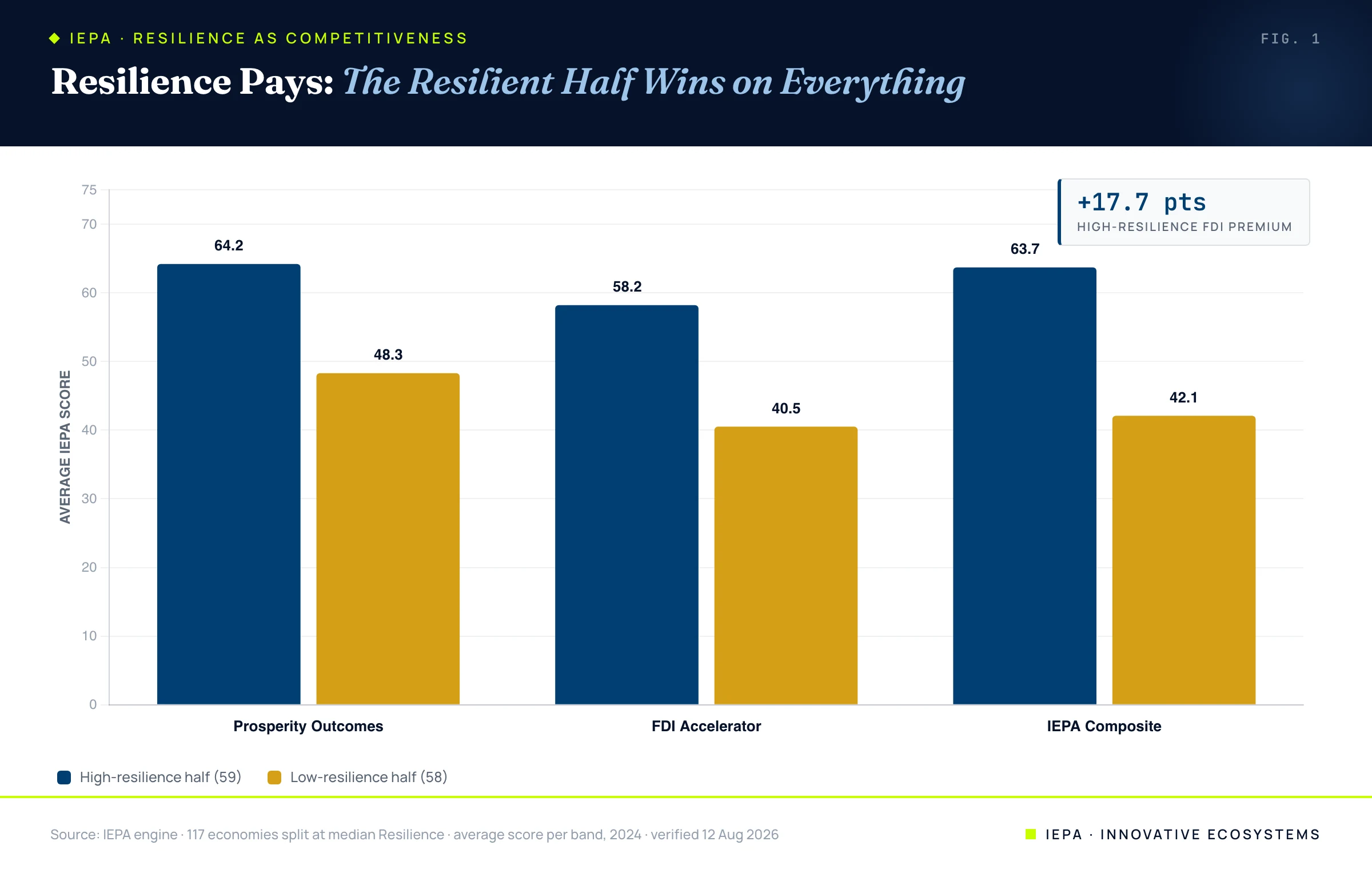
An eighteen-point edge in foreign investment is the most telling of the three, because it is the market voting with its own money. Investors do not pay a premium for stability out of sentiment. They pay it because a resilient economy lowers the discount rate on every future return, and that lower risk is worth more than a marginally higher headline opportunity in a place that might not hold. Resilience correlates with the composite at 0.89, higher than any other zone, because it is the soil. Innovation, entrepreneurship, and capital all grow faster in ground that does not give way.
03The Resilient Core and the Fragile Tail
The leaderboard is a study in what durable institutions look like when they compound for decades.
| Economy (2024) | Resilience | FDI Accel. | Prosperity |
|---|---|---|---|
| Finland | 85 | 62 | 61 |
| Sweden | 85 | 75 | 62 |
| Norway | 83 | 56 | 76 |
| Denmark | 81 | 77 | 75 |
| Switzerland | 80 | 51 | 74 |
| Venezuela | 30 | 15 | 52 |
| Myanmar | 27 | 28 | 32 |
| DR Congo | 24 | 64 | 39 |
Finland is the instructive case at the top. Its Resilience of 85 is its single strongest zone and the highest in the index, yet its Prosperity Outcomes reach only 61, the lowest of the resilient core in this table and fifteen points behind Norway on a nearly identical resilience base. That is the reminder that resilience is necessary but not sufficient: ground that holds is what lets an economy compound, not a guarantee that it will. The fragile tail makes the opposite point. The DRC posts an FDI Accelerator of 64, capital does arrive, drawn by resources, but on a Resilience base of 24 that capital stays extractive and transient. It never compounds into an ecosystem, because the ground will not hold one. Stability is what turns a flow of money into a stock of capability.
04An Asset, Not a Safety Net
The reframe this zone forces is the one the book set aside. A safety net is a pure cost: you fund it, you hope never to use it, and it produces nothing in the meantime. Resilience does not behave that way in the data. It produces, continuously, by lowering the risk that everyone else is pricing. In a decade defined by shocks, a pandemic, a war, an energy crisis, a supply-chain reordering, the economies that held their shape did not merely avoid losses. They captured the capital, the talent, and the supply chains fleeing the places that did not.
This is also where sustainability stops being a moral footnote and becomes a competitiveness input. Environmental performance and sustainable competitiveness sit inside this zone for a reason: they are leading indicators of whether an economy can keep operating under the physical and regulatory conditions of the next twenty years. The capital now rerouting toward green steel and secure supply is not being charitable. It is buying resilience because resilience is what survives to pay out.
A safety net catches you when you fall. Resilience is why the market bets you will not, and prices the bet in your favor.
05The Builder's Reading
For a region, Resilience is the slowest zone to build and the most valuable to hold. It cannot be bought in a budget cycle the way a fund or an incubator can, because it is made of institutions, rule of law, stability, and trust that accumulate over years. But it is the zone that underwrites every other one, and in a risk-repricing world it is the first thing a serious investor checks. A region that wants foreign capital to compound rather than merely visit has to be able to answer the question every allocator now asks first: when the next shock comes, does this place hold?
That is the question this week's supply-chain reordering is asking on a global scale, and the answer is sorting capital toward resilient ground. The work of building an ecosystem is, in large part, the work of building that answer: the institutions and stability that turn a country from a place money passes through into a place money stays. It is the least glamorous of the six lenses and, on this evidence, the one that decides whether the other five ever pay off.
Zone scores, the median-split bands, and correlations are computed on the live IEPA engine across 117 economies for the 2024 assessment year, the headline reference vintage, with later years treated as trend extension. Scores are normalized 0 to 100. No estimates. Figures were re-verified on 12 August 2026, following an upstream refresh of the underlying foreign-investment series.
- Ukraine's digital resilience is Europe's warning signal. Tech.eu, June 2026.
- Briguglio, L., Cordina, G., Farrugia, N., & Vella, S. (2009). Economic Vulnerability and Resilience: Concepts and Measurements. Oxford Development Studies, 37(3), 229–247.
- Martin, R., & Sunley, P. (2015). On the notion of regional economic resilience: conceptualization and explanation. Journal of Economic Geography, 15(1), 1–42.
- Institute for Economics & Peace. Positive Peace Report. The eight pillars of the institutions that sustain stability.
- Innovative EcoSystems. Alignment Is the Hidden Variable, and Why We Built Six Zones Instead of One Number. 2026.
- Innovative EcoSystems. The IEPA Index and Methodology. 2026.