Alignment Is the Hidden Variable
The zone nobody markets quietly predicts prosperity as well as innovation, and predicts capital nearly twice as well
The IEPA measures six zones of competitiveness. Five of them are the kind a development agency would put on a billboard. The sixth, Alignment, the coherence and quality of an economy's institutions and rule-of-law foundations, is the one nobody markets. The data suggests they have it backwards. Alignment predicts realized prosperity about as strongly as innovation or entrepreneurship, and far more strongly than foreign investment intensity. More striking still, alignment predicts foreign capital nearly twice as well as innovation does. The variable that everyone funds, capability, is a weak predictor of the capital it is supposed to attract; the variable nobody talks about is the strong one. Alignment is the hidden term that resolves the FDI Paradox.
- Alignment is a top-tier predictor of prosperity (r = 0.63), statistically tied with entrepreneurship and innovation, and double the predictive power of FDI intensity.
- Alignment predicts capital, capability does not. Alignment correlates with FDI attraction at 0.40; innovation correlates at just 0.23. Institutions pull in capital nearly twice as effectively as the production frontier.
- The alignment divide is enormous. The high-alignment half of the world attracts +18 points more FDI and realizes +15 points more prosperity than the low-alignment half.
- This is the institutions thesis, measured. What separates economies that convert capability into prosperity from those that do not is, overwhelmingly, the quality of their alignment.
Economies are sold on their visible strengths. They advertise their research output, their unicorns, their patents, the things a ribbon can be cut in front of. Almost no region holds a press conference about the coherence of its institutions. Yet across 117 economies, institutional alignment turns out to be one of the most powerful variables in the entire index, and the single best predictor of the one thing those press conferences are usually trying to attract.
01The Zone Nobody Advertises
The IEPA's Alignment zone measures something unglamorous: whether an economy's institutions point in the same direction. The coherence of its governance, the predictability of its rule of law, the degree to which its public commitments are credible and its rules are applied evenly. It is not a measure of how clever an economy is or how much money flows through it. It is a measure of whether the machinery underneath works.
Because it photographs poorly, alignment is chronically under-sold. Regions compete on innovation rankings and startup counts; they do not compete on institutional coherence, even though, as we will show, it is doing more quiet work than almost anything they do advertise. To see how much, we simply asked the index which zones actually predict the outcome every economy claims to want.
02What Actually Predicts Prosperity
The IEPA separates the five input zones of competitiveness from the realized end, Prosperity Outcomes. That lets us rank the inputs by how well each one predicts the prosperity an economy actually achieves. The ranking is quietly subversive.
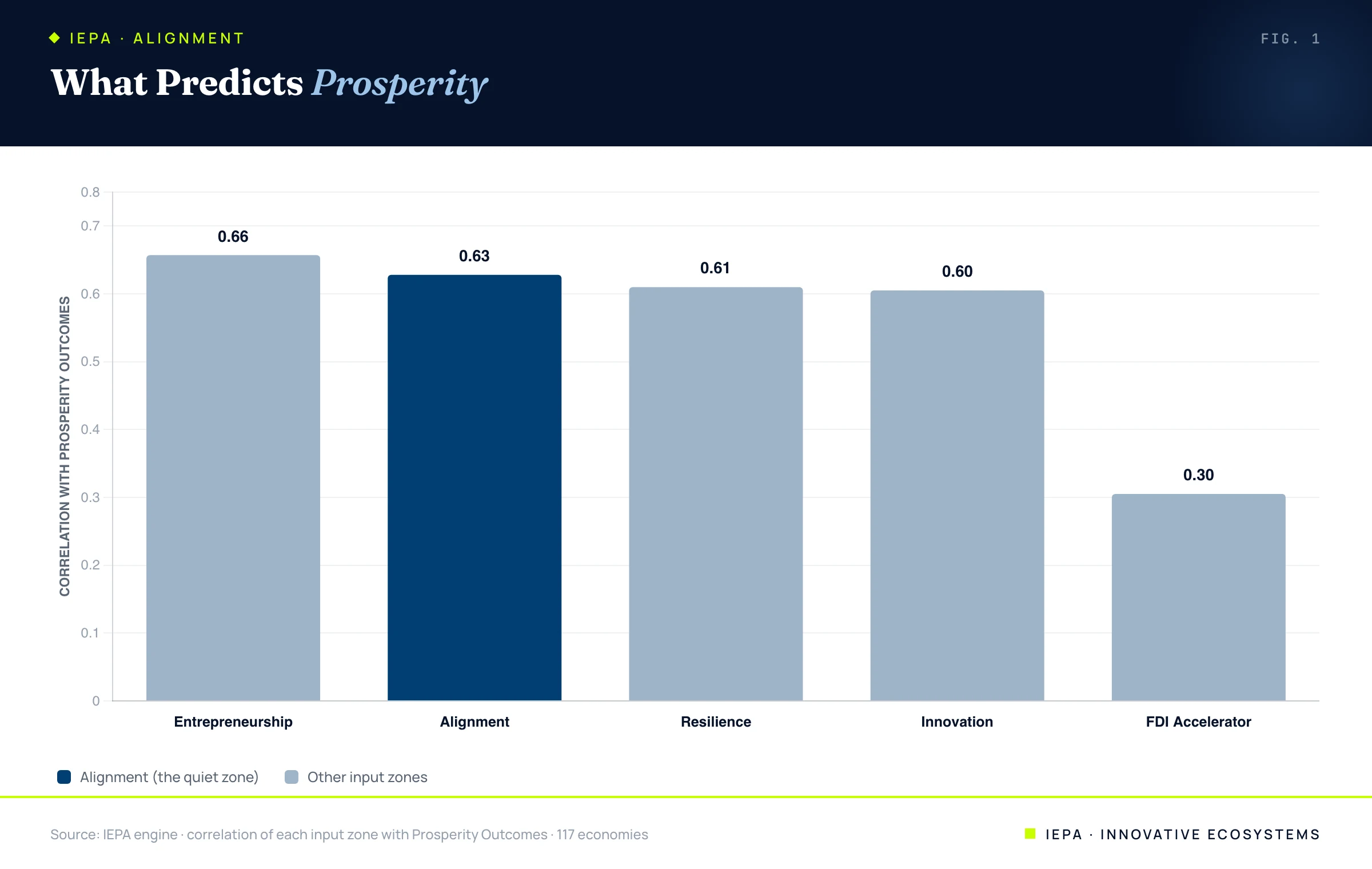
Alignment ranks among the strongest relationships with prosperity in the entire index, at 0.63, in a statistical dead heat with entrepreneurship, resilience, and innovation at the top of the input zones. The zone nobody markets predicts the outcome everybody wants as well as the zones they spend their entire budgets on. Meanwhile foreign-investment intensity, the input regions chase hardest, is the weakest predictor of prosperity of all five. The thing economies advertise least turns out to matter most; the thing they chase hardest turns out to matter least.
03The Hidden Variable
The deeper finding is not about prosperity but about capital, and it reaches back into a paradox we have documented before. Our work on the FDI Paradox showed that innovation capacity barely predicts how much foreign investment an economy attracts: the correlation is a negligible 0.23. Capability, the thing every region funds to attract capital, does almost nothing to attract it. That left an obvious question unanswered. If not capability, then what?
Alignment is the answer.
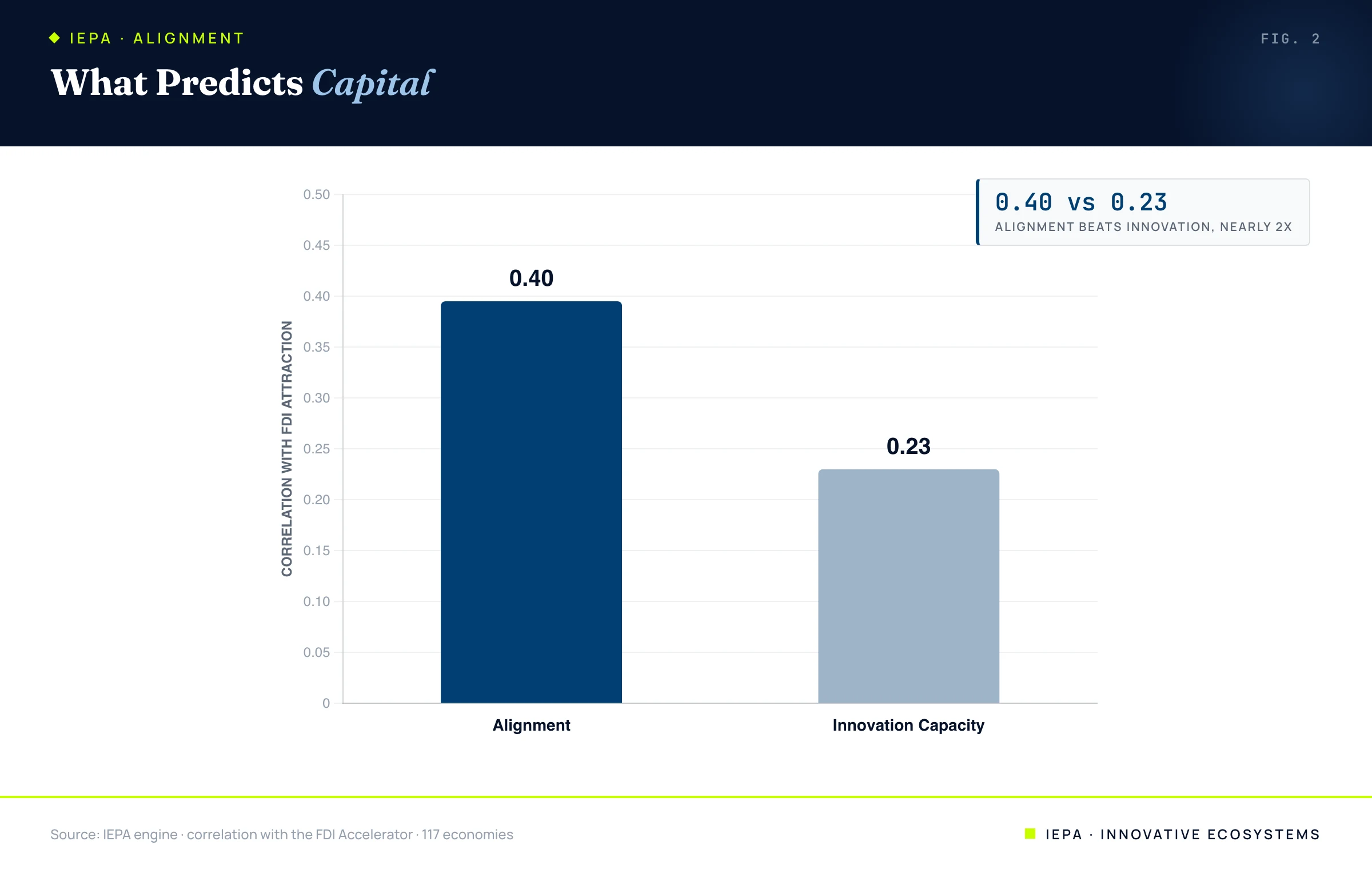
Institutional alignment correlates with foreign-investment attraction at 0.40, nearly double innovation's 0.23. Capital does not chase capability; it chases coherence. This is intuitive once stated, and almost never acted upon. An investor deciding where to commit money for a decade is not primarily asking how many patents a country files. They are asking whether contracts will be honored, whether the rules will hold, whether the institution they are entering points in a stable direction. They are pricing alignment, and the data shows it.
China makes the point at full scale. It ranks eighth in the world on innovation capacity and near the bottom on institutional alignment, and it attracts less foreign capital, relative to the size of its economy, than any country in the index. The capability is genuine and world-class. The coherence is not, and capital prices the coherence. Singapore is the mirror image: rarely the most inventive economy in any comparison, but supreme on the predictability of its institutions, and the recipient, for half a century, of investment that more brilliant and less governed economies cannot draw. Between them they make the abstract concrete. The patents do not move the money. The institutions do.
Alignment is the hidden variable that the FDI Paradox left blank: the reason capable economies fail to attract capital is, more than anything else, that their institutions do not give capital a reason to feel safe.
Capital does not chase capability. It chases coherence. The variable that attracts investment is the one nobody puts on a billboard.
04The Alignment Divide
The strength of these correlations translates into a stark gap between the world's well-aligned and poorly-aligned economies. Splitting all 117 economies at the median of alignment and comparing the two halves makes the stakes concrete.
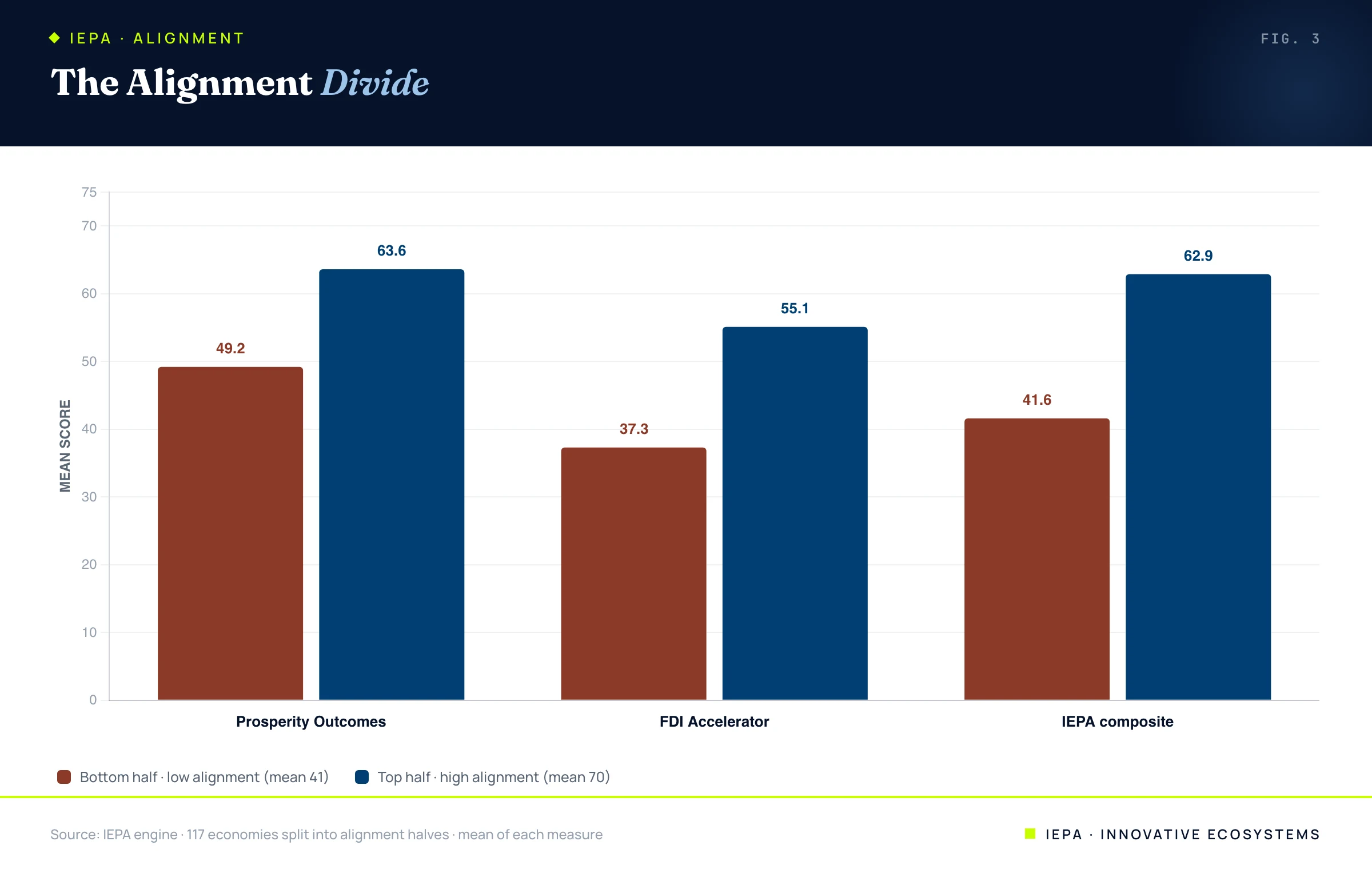
The economies in the top half of alignment attract, on average, 55 points of FDI intensity against the bottom half's 37, a gap of nearly 18 points on the very zone that capability cannot move. They realize 64 points of prosperity against 49. And they score 63 on the overall index against 42. Whether you care about capital, about outcomes, or about the composite, the high-alignment half of the world is in a different league, and the line that divides them is not how clever they are but how coherent.
05The Institutions Thesis, Measured
None of this is theoretically new. The argument that institutions are the fundamental cause of prosperity, that nations grow rich when their institutions are inclusive and credible and stay poor when those institutions are extractive and arbitrary, is among the most influential ideas in modern economics, recognized with the 2024 Nobel for the work of Acemoglu and Robinson and others. What has been harder is to see the mechanism cleanly in cross-country data, because the conventional measures bundle institutions together with everything else.
The IEPA's contribution here is to isolate the variable. By scoring alignment as its own zone, separate from capability and from outcomes, the index can show institutions doing their work directly: predicting prosperity as strongly as innovation, predicting capital nearly twice as strongly, and sorting the world into two halves that live very differently. The institutions thesis is not invoked as authority. It is reproduced as a result, on live data, with the mechanism visible.
06What Alignment Means for Strategy
For any region trying to attract investment, the strategic implication inverts the usual playbook. The default move is to pour resources into the visible inputs, the labs, the incubators, the innovation scoreboards, on the theory that capability summons capital. The data says capability barely moves capital. What moves capital is the credibility of the institution the capital would enter. Governments increasingly act on exactly this. In mid-2026 Thailand launched an investor Fast Pass to cut the bureaucratic friction that sits between capital and the projects it would fund, a wager not on new capability but on the legibility of the institution capital has to pass through. That is alignment, priced and acted on.
This does not mean a region should stop building capability; capability still predicts prosperity strongly. It means that a region whose institutions are coherent has an underpriced asset, and a region whose institutions are not has a binding constraint that no amount of innovation spending will relieve. For Innovative EcoSystems, this is why alignment sits at the center of how we read a region. Our HoldCo-to-SPV architecture is, in part, an alignment instrument: by packaging public anchors and underwritten commitments into credible, legible vehicles, it manufactures exactly the institutional coherence that capital is shown to price, supplying the hidden variable rather than waiting for a region to build it from scratch.
All zone-level scores and the correlation statistics are computed from the proprietary IEPA engine maintained by Innovative EcoSystems. Related sources below.
- Acemoglu, D., & Robinson, J. A. (2012). Why Nations Fail: The Origins of Power, Prosperity, and Poverty. Crown Business.
- World Bank. Worldwide Governance Indicators.
- World Justice Project. Rule of Law Index.
- Innovative EcoSystems. The IEPA Index, The FDI Paradox, and State of the Index 2026 (companion papers).
- UNCTAD (2024). World Investment Report 2024.
- Government launches new Thailand Fast Pass for investors. Bangkok Post, June 2026.