The Entrepreneurship Capacity Gap
Invention is becoming common. The ability to turn it into a company is the most unequal capability we measure.
The second IEPA zone, Entrepreneurship Capacity, measures whether an economy can turn ideas into firms: founder density, early-stage finance, the pathways to scale, and the institutions that let a company form and grow. It is where the index spreads furthest, and where the spread matters most.
- It is the widest buildable gap. Entrepreneurship Capacity runs from 5 in Iraq to 92 in the United States, an 87-point chasm. Its spread is the largest of any capability an economy can build, trailing only the conduit-distorted FDI zone.
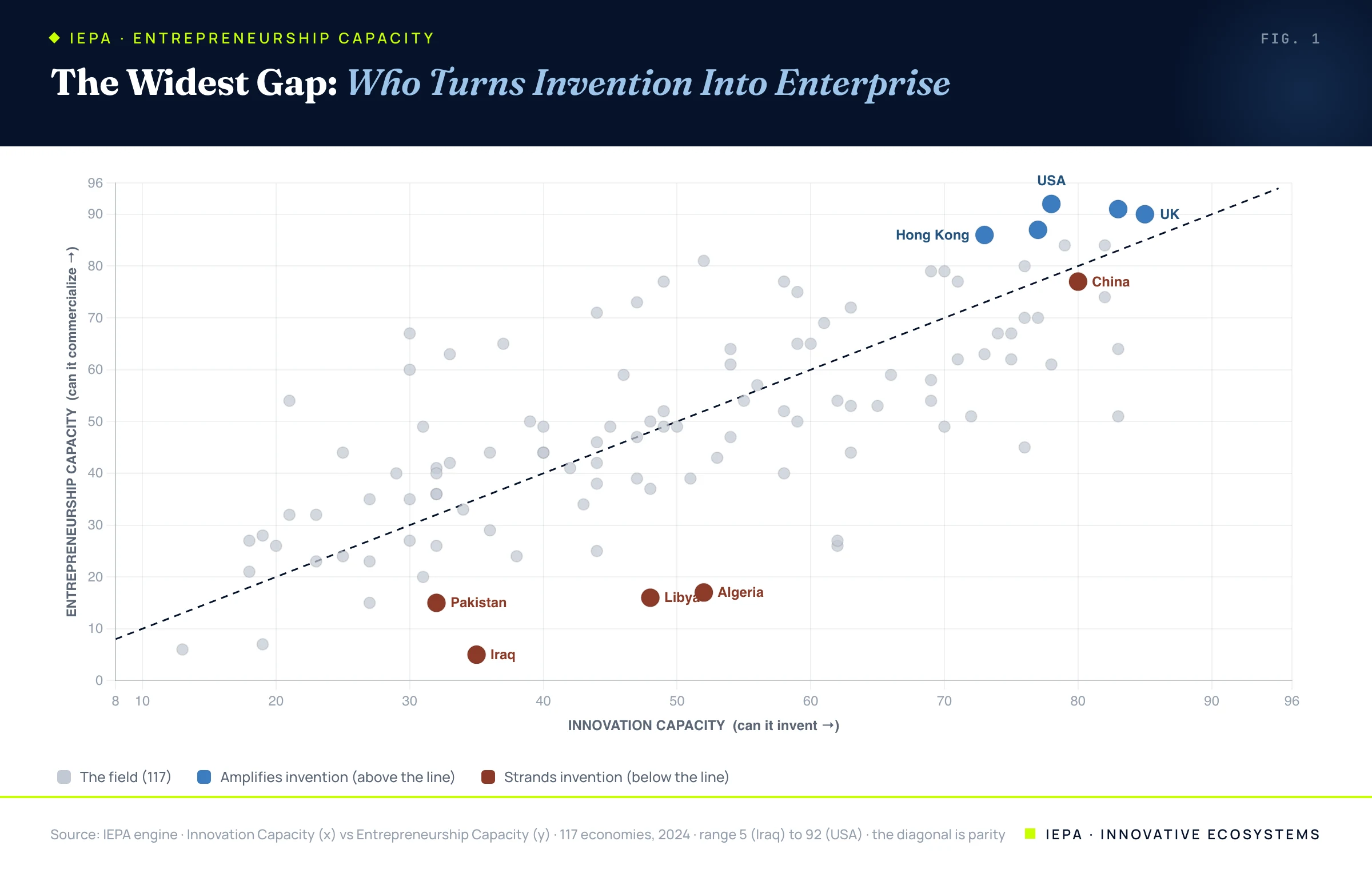
- It is the amplifier. The leaders score higher on entrepreneurship than on invention. The United States runs 78 on innovation and 92 on entrepreneurship; the United Kingdom 85 and 90; Switzerland 83 and 91. They turn what they invent into firms. Algeria inverts it, with innovation 52 and entrepreneurship 17.
- The gap is institutional, not innate. Algeria, Libya, and Iraq are not short on capable people. Entrepreneurial talent is roughly universal, as William Baumol argued; what differs is whether the rules channel it into building firms or into rent-seeking.
- It is the highest-leverage capability to close. Entrepreneurship is the strongest single capability correlate of prosperity (r = 0.66) and responds to policy faster than an innovation base does. It is where the conversion happens.
In the forty-eight hours around the 22nd of June 2026, our feed logged founders raising capital in the Netherlands, Lithuania, Czechia, Morocco, the UAE, and across the Gulf, while a Danish organizer won a grant to connect Nordic investors with African startups. Capital is hunting founders on every continent now. What it cannot manufacture is the thing that turns a founder with an idea into a financed, scaling company. That capacity, the second zone in the IEPA index, is the most unequally distributed of any capability we track.
01What the Zone Measures
Entrepreneurship Capacity is the commercialization layer of an economy. It captures the density of people starting firms, the availability of early-stage capital, the legal and procedural ease of forming and dissolving a company, the access to first customers and markets, and the cultural and institutional tolerance for the risk involved. It is deliberately separate from Innovation Capacity, which measures whether an economy can invent, and from the FDI Accelerator, which measures the capital that flows in. This zone asks a narrower, harder question: when someone has an idea, can they build a business out of it here?
Joseph Schumpeter put the entrepreneur at the center of economic change for exactly this reason. Invention sits inert until someone carries it into the market, and that carrying, the founding and scaling of the firm that turns a new thing into a going concern, is the act that drives growth. Innovation supplies the raw material. Entrepreneurship is the conversion.
02The Widest Gap We Measure
Lay the zone out across all 117 economies and the distance is startling. From Iraq at 5 to the United States at 92, Entrepreneurship Capacity spans nearly the entire scale, with a standard deviation wider than any other capability the index measures. The only zone that varies more is the FDI Accelerator, and we have shown elsewhere that its spread is an artifact of conduit economies rather than a real difference in capability. The entrepreneurship gap is real.
03Amplify or Strand
The diagonal in that chart is the line where an economy's capacity to commercialize exactly matches its capacity to invent. What an economy does relative to that line is the whole story of this zone. Sit above it and you amplify: you turn out more enterprise than your invention alone would predict. Sit below it and you strand: you generate ideas that never become companies.
| Economy (2024) | Entrepreneurship | Innovation | Prosperity |
|---|---|---|---|
| United States | 92 | 78 | 72 |
| Switzerland | 91 | 83 | 74 |
| United Kingdom | 90 | 85 | 67 |
| Hong Kong | 86 | 73 | 72 |
| Algeria | 17 | 52 | 42 |
| Libya | 16 | 48 | 35 |
| Iraq | 5 | 35 | 33 |
The amplifiers are familiar names, and the pattern is consistent: each posts a higher entrepreneurship score than innovation score. They are not necessarily the world's most inventive economies. They are the best at converting whatever they invent into firms. The stranders are the more instructive cases. Algeria carries an innovation capacity of 52, real and measurable, on top of an entrepreneurship capacity of 17. Iraq pairs 35 with 5. These are not economies without ideas. They are economies where an idea has almost nowhere to go. Invention without entrepreneurship is not an asset sitting in reserve. It is a cost with no return.
04The Gap Is the System, Not the People
The temptation is to read a low entrepreneurship score as a statement about a population, that some places simply produce fewer entrepreneurs. The evidence runs the other way. William Baumol's enduring argument is that the supply of entrepreneurial talent is roughly constant across societies, and that what varies is allocation: whether the prevailing rules reward people for building productive firms, or for unproductive rent-seeking and worse. Where formation is slow, finance is absent, and the surest path to wealth runs through a permit or a connection rather than a product, talent does not vanish. It is redirected, away from the company that would have shown up in this zone.
That is why the gap is, in the language of the index, a capability and not a verdict. The Global Entrepreneurship Monitor has spent two decades documenting that entrepreneurial intent and activity appear everywhere, including in many economies that score poorly on the institutions that would let that activity compound. The raw material is present. The machine that converts it is not.
Invention is a spark. Entrepreneurship is whether anything catches. Most of the world has the spark.
05The Builder's Reading
Two facts make this the highest-leverage zone for anyone building an ecosystem. The first is that entrepreneurship is the strongest single capability correlate of realized prosperity in the index, at r = 0.66, ahead of innovation and alignment. When this zone moves, outcomes tend to follow. The second is that it is the most responsive to deliberate action. An innovation base takes a generation of universities and research to build. The conditions that lift entrepreneurship, faster company formation, early-stage capital, procurement access, real pathways to scale and to export, can be installed in quarters and years. This is precisely the conversion machinery we build, the apparatus that turns a region's existing invention into companies, customers, and revenue.
Which is the quiet lesson in this week's run of fundraises. The capital found founders in Amsterdam and Vilnius and Casablanca because the capacity to receive it was already there. The Danish grant to connect Nordic investors with African startups is an attempt to bridge the gap directly, capital on one side, founders on the other, the conversion layer thin in between. Closing that layer, market by market, is the work. It is also the fastest route a region has to turning what it already knows into what its people actually get.
Zone scores, the standard-deviation comparison, and the innovation-to-entrepreneurship field are computed on the live IEPA engine across 117 economies for the 2024 assessment year, the headline reference vintage, with later years treated as trend extension. Scores are normalized 0 to 100. No estimates.
- Danish TechBBQ secures grant to connect Nordic investors with African startups. TechCabal, June 2026.
- Baumol, W. J. (1990). Entrepreneurship: Productive, Unproductive, and Destructive. Journal of Political Economy, 98(5), 893–921.
- Schumpeter, J. A. (1942). Capitalism, Socialism and Democracy. Harper & Brothers.
- Global Entrepreneurship Monitor. Global Report, 2024 to 2025.
- Innovative EcoSystems. Innovation Capacity Is Not Innovation Output, and Why We Built Six Zones Instead of One Number. 2026.
- Innovative EcoSystems. The IEPA Index and Methodology. 2026.
A Lottery in Sana'a
820 firms applied for 200 grants and the winners were drawn in public. Transparent allocation and a valid control group turn out to be the same act.
→Explore the IEPA
Six zones, every market this research is scored from.
→Open the Atlas
The live global registry this research is drawn from.
→